The Transformation: From Story to Film

  • Preserve the stories, memories, and lived wisdom within your family before they fade, and shape them into a documentary that can be shared.

  • Turn scattered memories and archives into one clear, compelling story with a strong point of view that holds attention.

  • Follow a clear, paced structure with expert guidance that keeps your documentary progressing from start to finish.

  • Interview family with confidence and care, so you capture honest material without damaging trust or creating awkwardness.

  • Make something that resonates beyond your relatives, with a universal thread that connects with wider audiences.

Make Your Family Story Into a Documentary Short

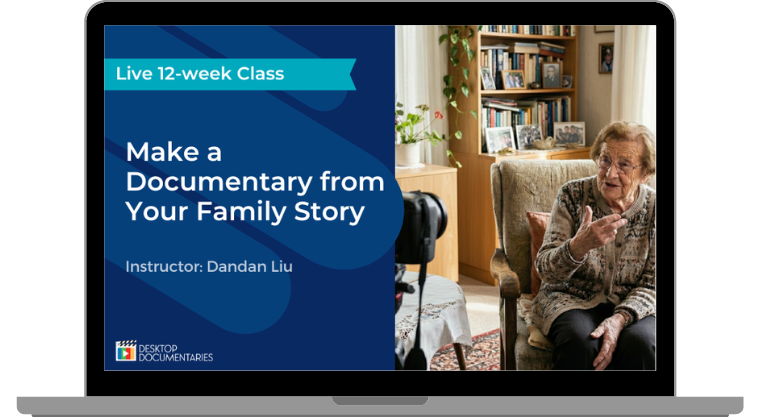
You don’t need to go far to find rich stories. Make a Documentary from Your Family Story is a 12 week guided course that helps you turn the people, places, and moments that shaped you into a short documentary, with a clear path from idea to finished film.

Led by award winning documentary filmmaker and coach Dandan Liu, the class focuses on documentary craft through the specific lens of filming family. You’ll learn how to shape a story, approach interviews, and work meaningfully with photos, home archive, and new footage.

Across the course you’ll be actively making your documentary, not just learning theory. Most students complete a 3 to 5 minute short, and even if you need more time, you’ll leave with strong progress and a clear path to finishing.

What Students Say About Dandan's Classes

"Dandan is a super talented filmmaker and this is exactly what I needed, since I'll be shooting my first short documentary in the coming weeks. I already had the basics down...but this filled in a lot of blanks for me and I'll be heading into my upcoming project with a lot more confidence. Thank you, Dandan!"
- by Riko Robinson

"When we learn different skillsets the focus is always on the 'How to' and that is an essential part of learning a skill, but what makes the learning effective is learning the 'Why', and that is brought out so clearly by Dandan in the class. It doesn't matter at which level you are at as a filmmaker, as there is always something more to learn, and the way the class has been presented with examples and actionable steps, only motivates one to take a closer look at the whole process of filmmaking!" 
- by M Nizam

"Awesome! Even as someone with several short documentaries under my belt, I found plenty of new techniques in this simply laid out course that I will be bringing to future projects. Well done!" -
- by George Hayward

Class Details

Format: 12 weekly 1 hour group sessions with Dandan, guiding you through the process of creating your documentary short. Each week you'll also be given new tutorial material to watch and tasks to complete as you begin your journey as a documentary filmmaker. 

Availability: The classes will run from January to April. Live classes will be on Zoom, and recordings made available for replay. 

Exclusive Resources: Course downloads to support your shoot and journey, including a simple lighting kit checklist, exposure guide, f-stop chart, release form template, and the Filmmaker’s Success Path guide.

Who Should Join? This course is for you, if you:

  • Want to make a short documentary based on a personal or family story

  • Are a beginner or early stage filmmaker looking for a clear, guided process

  • Are starting with interviews, old photos, home archive, or unfinished ideas

  • Feel stuck at the idea stage or overwhelmed by material

  • Want steady, week by week progress toward a film you can actually share

If you're ready to move beyond inspiration and make real progress, you'll fit right in

Build Your Documentary, Week by Week

Each week is built around a live 1-hour call with Dandan, where you’ll get guided teaching, prompts to move your project forward, and time for Q&A. 

Alongside the calls, you’ll get a set of super-distilled video tutorials that cover exactly what you need for that week, without hours of extra viewing. The emphasis stays where it should: on doing the work. Every week includes clear homework tasks designed to move your project one step closer to a finished short.

Week by week, you’ll move from foundations to filming to a finished cut.

  • Week 1: Welcome + Foundations

  • Week 2: Story, Structure + Vision

  • Week 3: Pre-Production I (Interview + Archive Plan)

  • Week 4: Pre-Production II (Shoot Planning)

  • Week 5: Getting Great Audio (Equipment and Ground Rules)

  • Week 6: Cinematography Basics (Light, Composition, Exposure)

  • Week 7: Production Week I (Interview + B-Roll)

  • Week 8: Production Week II (Interview + B-Roll)

  • Week 9: Editing Prep (Organise + Selects)

  • Week 10: Premiere Pro Basics (Interface + Setup)

  • Week 11: Build Your Cut (Add B-Roll and Music)

  • Week 12: Finalise + Export (Polish + Wrap-Up)

Meet Your Instructor

Filmmaker | Contemplative Creative Dandan Liu

Hi there! I’m Dandan, an ex-scientist turned Emmy award-winning documentary filmmaker who loves foraging for unique stories around the world that reveal the connections between people and place.

I started making films while on a 4 year journey living in monasteries around the world and my 10th film 'Dottie' won a Regional Emmy Award from the National Academy of Television Arts and Sciences.

My work embraces a minimalist and heart driven approach to storytelling, with an intimate focus on the moments that carry the deepest meaning.

Cheering you on,
Dandan

"The portions that are specifically technical in nature would be best for a beginner in film. The portions that give techniques on how to format and create an interview documentary can be gleaned from someone at any level. Her clarity and step-by-step instruction with visuals is fantastically done. This course stands above and beyond... Thanks!"

 - by Marco Viani

FAQ

  • Can I still make a film if my main characters are in the past and I only have archival material?

    That can still work, and you’re not alone. Many powerful documentaries are built primarily from archive, photographs, letters, objects, locations, and research, with little or no on-camera interviews. In the course, you’ll learn how to shape a story when your “main characters” are in the past: how to build scenes from archival material, how to use narration or text sparingly and effectively, and how to film present-day visuals (places, objects, details) that bring the past to life.

    If interviews aren’t possible, we’ll help you choose an approach that still creates momentum and emotional connection.

  • What if I don't already know a family story to use, but am keen to learn doc filmmaking?

    You can still join. Many students arrive with a general sense of “there’s something here” but no clear story yet. Early in the course we’ll help you generate and test a few possible directions, so you can choose a story that’s realistically filmable and meaningful.

    And if you truly don’t have a specific family story you want to use right now, the skills you’ll learn still apply directly to any short documentary: interviewing, working with archive, shooting B-roll, and building a first edit. You can use the course to develop your filmmaking craft while you discover the right subject.

  • What is the time commitment for this each week?

    You can move through the course at your own pace. But if you want to keep up with the 12-week schedule and actively make your documentary alongside the group, plan on a few hours each week, or a dedicated weekend day for filming and editing as needed.

  • Do I need to be able to attend every group session?

    No. While joining live is great for momentum and feedback, you don’t need to attend every session. All group calls will be recorded, so you can catch up on your own schedule.

  • Do I need professional filmmaking gear to do this course?

    These days you don’t need expensive professional gear to capture strong documentary footage. If you don’t already own a dedicated camera, a modern smartphone is more than capable of producing high-quality video, especially with decent lighting and a simple setup.

    The one place we do recommend investing a little is audio. A small external microphone for interviews can make a huge difference, and there are solid options available for under $30. We’ll share specific recommendations at the start of the course.

  • Do I need to use Adobe Premiere Pro for the editing lessons?

    Dandan will demonstrate editing using Adobe Premiere Pro, including a beginner-friendly introduction to the interface and core editing basics. That said, you’re welcome to use whatever editing software you’re most comfortable with, since the storytelling and editing principles we cover apply across platforms.

  • Do I need to get permission from the people being filmed or interviewed?

    Yes. You should always get clear, informed permission from anyone you plan to film or record, and have that conversation before you ever hit “record.” If you plan to share the film publicly, it’s best practice to get permission in writing (especially for interviews). If you’re filming minors, you’ll need consent from a parent or guardian. And if you’re using family photos, letters, or other archival material, you’ll also want to be mindful of who owns it and who is comfortable with it being included. We’ll cover the practical basics in the course and share simple guidance to help you handle this respectfully.

  • What will I have at the end of the course?

    By the end of the 12 weeks, most students will have completed a 3–5 minute documentary built from their own family story. Even if you need more time, you’ll leave with real progress, a clear plan to finish, and the confidence to continue developing personal documentary projects.